
Dear Washington STEM community:
When I joined Washington STEM nearly a decade ago, I knew I was joining an organization committed to expanding opportunity and justice for young people across our state. What I couldn't have imagined then was the privilege of helping lead this organization into its next chapter as CEO.
Over the past nine years, I have had the opportunity to work alongside extraordinary colleagues, educators, employers, researchers, policymakers, philanthropists, and community leaders who believe that every young person in Washington deserves the opportunity to pursue a future of their choosing. Together, we have helped advance early STEM learning and a sense of belonging in math, expanded pathways into high-demand careers, strengthened regional education-to-workforce partnerships, and built trusted data tools that help communities make better decisions for learners. These accomplishments belong to many people, not any one individual.
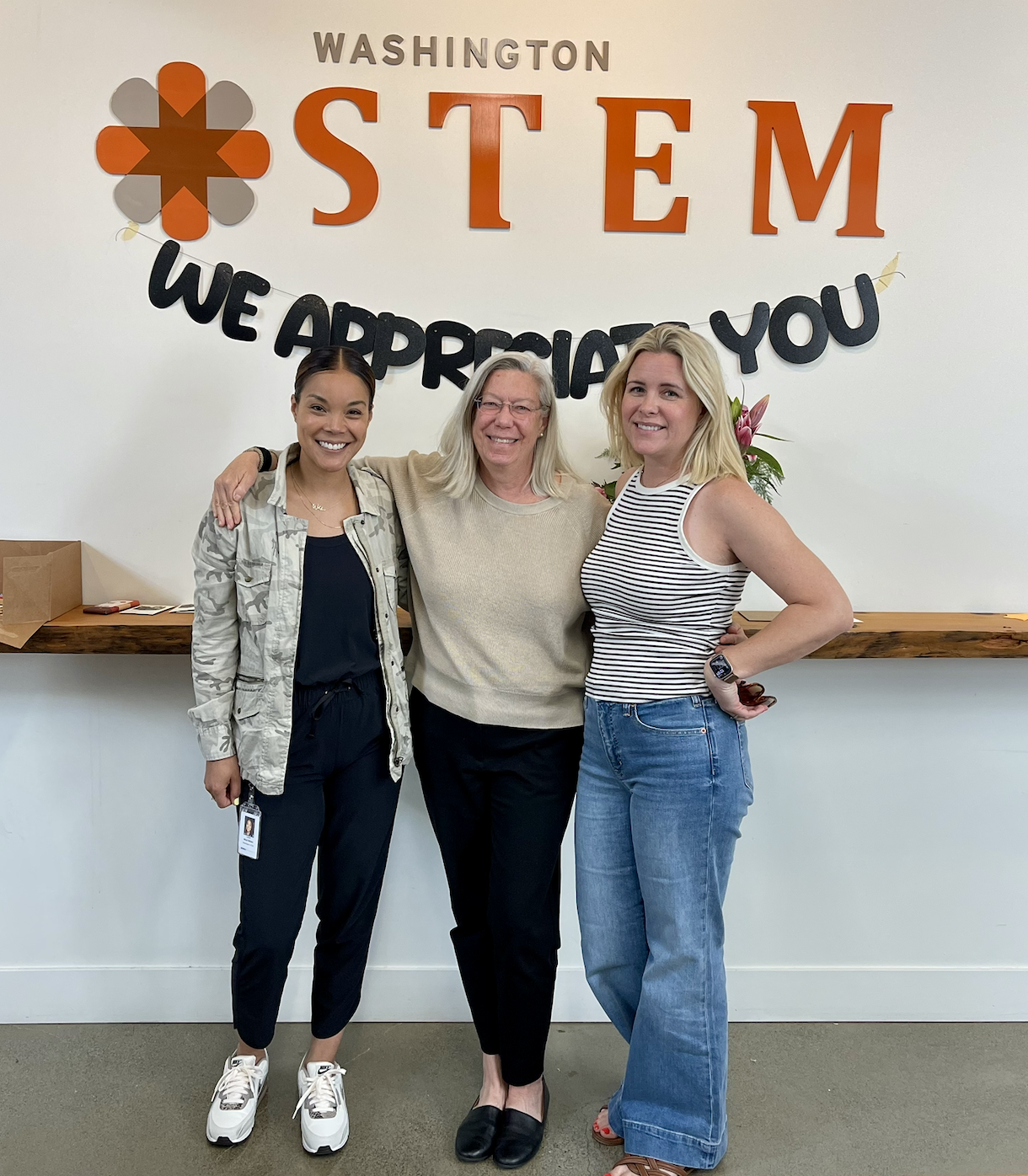
I have been especially fortunate to partner with organizations and leaders across Washington who continue to challenge and inspire me—from regional education and workforce partnerships and school districts to higher education institutions, employers, state agencies, philanthropy, and organizations. I am proud to call the leaders of our state’s organizations friends and co-conspirators: Washington State Board for Community and Technical Colleges, the Office of Superintendent of Public Instruction, the Washington Student Achievement Council, regional workforce development councils, and many others who have worked alongside us to strengthen Washington's education and workforce systems. Every milestone Washington STEM has achieved has been built through relationships grounded in trust, shared purpose, and a willingness to solve difficult problems together.
As I step into this role, my leadership is grounded in a few simple beliefs.
- First, I believe in an abundance mindset. Washington has extraordinary talent, creativity, and capacity. Our work is not about competing over limited opportunity—it is about expanding opportunity so that every learner, regardless of race, geography, income, or gender, can build a future filled with possibility.
- Second, I believe systems will bring about change, not heroes. Sustainable change does not happen because of one leader or one organization. It happens when we build institutions, partnerships, and policies that continue creating opportunity long after any individual has moved on. My responsibility as CEO is not to become indispensable; it is to help build systems that are.
- Third, I believe culture is something we build intentionally. Trust grows through consistency. Shared purpose grows through clarity. Organizations do their best work when people understand where we are going, how decisions are made, and how their work contributes to something larger than themselves.
- Finally, I believe accountability is one of the deepest forms of respect. Being clear about expectations, making difficult decisions with transparency, and holding ourselves accountable to the communities we serve are not in tension with compassion—they are expressions of it.
These principles will shape how we lead internally, because the kind of organization we become matters just as much as the work we produce. As such, I am focused on understanding the forces shaping the future our students will inherit—from AI and emerging technologies to the economic and societal changes unfolding alongside them. The choices we make today—in education, policy, business, and our communities—will determine whether these technologies expand opportunity or deepen existing inequities.
By advancing STEM literacy and strengthening equitable pathways to credentials and careers, we can ensure young people are prepared not only to navigate change, but to shape it. This has always been Washington STEM's work, but the stakes have never been higher. As new technologies become part of everyday life, we have an important role to play in helping ensure they serve people, strengthen communities, and create a future where every learner has the opportunity to thrive.
Washington State is entering a period of extraordinary change. Artificial intelligence, emerging technologies, demographic shifts, and economic transformation are reshaping education, work, and civic life. While no one can predict exactly what comes next, I believe we must prepare for several possible futures.
In one future, technological change unfolds gradually, and existing systems adapt over time. In another, workforce disruption accelerates, requiring rapid reskilling and new career pathways. In a third, the relationship between education, credentials, and work is fundamentally reimagined. Regardless of which future emerges—or whether reality includes elements of all three—Washington STEM has an essential role to play.
Alongside my colleagues, I will continue building Washington STEM into a disciplined, trusted, future-focused systems leader—expanding opportunity through STEM literacy and equitable pathways to education and career. I believe organizations achieve lasting impact when they intentionally cultivate clarity, trust, accountability, and shared purpose. My leadership is rooted in stewardship, courage, abundance, and human agency—building systems that endure beyond any individual while ensuring that emerging technologies and societal change are shaped in service of people and communities, not the other way around.
Our organization is embracing a shared model of leadership—one that shares responsibility, develops leadership at every level, and recognizes that the best ideas often emerge closest to the work and closest to the communities we serve. This is not simply an internal management philosophy. It reflects the future we hope to see across Washington's education ecosystem.
For too long, many of our systems have concentrated power far from students, families, educators, and local communities. Lasting systems change requires shifting decision-making closer to those most affected, strengthening regional leadership, valuing lived experience alongside research and data, and building networks in which responsibility and accountability are shared. Again–the future of education and workforce development will depend less on individual institutions acting alone and more on our collective ability to lead together.
That is the kind of leadership I hope Washington STEM can model.
As I begin this next chapter, I do so with deep gratitude—for the trust of our Board of Directors, the extraordinary dedication of our staff, the wisdom of our partners, and the communities who continue to challenge us to do better.
Washington STEM has spent the last fifteen years building credibility as a trusted intermediary and systems leader. The next chapter is about building on that foundation with courage, discipline, and optimism.
I am honored to serve as CEO, and even more honored to continue this work alongside all of you.
Together, we have an opportunity—and a responsibility—to help build an education and workforce system that prepares every learner not just for the future they inherit, but for the future they will help create.
With gratitude,
Jenée Myers Twitchell, PhD
Chief Executive Officer
Washington STEM
.png)
.png)
